
Madagascar Vanilla Beans
Madagascar is the reference. When a pastry chef, an extract producer, or a consumer says “vanilla,” the flavor they mean is almost always Madagascar Bourbon — sweet, round, creamy, unmistakably familiar. Roughly three-quarters of the world’s natural vanilla comes from one island, and most of that from one region on its northeast coast.
Evanille supplies Madagascar vanilla beans alongside our own Ugandan production, and the difference between those two sentences is the basis of how we sell. Uganda is our own operation — we source green pods, cure, grade and run QC at our own facility through E. Vanille Holdings Ltd. Madagascar is an origin we supply through vetted partners: we do not own farms, curing sheds or a grading table there, and we will not pretend otherwise. What we bring to it is specification discipline, lot documentation, and a buyer who knows what a badly cured bean looks like.
Current availability, pack sizes and lead times for Madagascar lots are confirmed on request. Text +1 786-896-8446 or request a quote and samples.
What “Bourbon” actually means
Bourbon is not a bean variety, not a curing style, and has nothing to do with whiskey or barrels. It is a geographic designation, and it comes from an island name.
Réunion, in the Indian Ocean, was claimed by France in 1642, named Île Bourbon after the ruling dynasty, and kept that name until 1848. It was there, in 1841, that a twelve-year-old named Edmond Albius worked out the hand-pollination technique that made vanilla cultivation possible outside Mexico, where the crop’s native pollinators live. Every commercial vanilla flower on earth is still pollinated by hand using essentially his method.
The vanilla exported from those islands took the island’s name with it, and the label stuck. Today “Bourbon vanilla” designates Vanilla planifolia grown in the Indian Ocean group: Madagascar, Réunion, the Comoros, Mayotte, Mauritius and the Seychelles. Madagascar grows the overwhelming majority of it, which is why “Madagascar Bourbon vanilla beans” reads as one phrase even though it is two claims stacked together — one about the country, one about the island group and the curing tradition that came with it.
Two practical consequences for anyone writing a label or a spec sheet:
- “Bourbon” tells you the region, not the quality. A poorly cured Bourbon bean is simply a poorly cured bean.
- Uganda is not Bourbon. It is the same species, Vanilla planifolia, cured by the same Bourbon method, but mainland East African origin sits outside the designation. That is a labeling fact, not a flavor judgment.
Flavor profile: the benchmark everything else is measured against
Madagascar’s value is not that it is the most intense vanilla. It is that it is the expected vanilla. The profile is sweet, creamy and rounded, with a soft woody edge and a long, clean finish — no smoke, no sharp phenolics, nothing that has to be explained to a customer. Well-cured Grade B lots typically run around 1.5–2% vanillin, which is solid rather than extreme.
That familiarity is the commercial asset. If you are reformulating, Madagascar is the control sample. Here is how the four origins we supply compare:
| Origin | Species | Flavor profile | Typical vanillin | Suits |
|---|---|---|---|---|
| Madagascar | V. planifolia | Sweet, creamy, classic; light woody finish | ~1.5–2% | Label claims, custards, ice cream, classic extract |
| Uganda | V. planifolia | Bold, chocolate and fig, earthy depth | 2.5% (our own lots) | Extraction, baking, brewing — anything with heat or fat |
| Ecuador | Mostly V. × tahitensis | Floral, cherry and stone fruit, anise | ~1–1.7% | Cold and low-heat pastry, finishing, signature items |
| Indonesia | V. planifolia | Woody, phenolic, smoky, tobacco edge | ~1.5–2% | Volume extraction, dark bakes, cost-driven manufacturing |
Indicative ranges for well-cured commercial lots, not guarantees. Final figures for your batch come on the Certificate of Analysis that ships with the order.
The blunt version: Madagascar is the safe answer, Uganda is the strong one, Ecuador is the interesting one, Indonesia is the cheap one. Most serious buyers end up holding two of the four. The bean-for-bean argument between the top two is laid out in Ugandan vs. Madagascar vanilla.
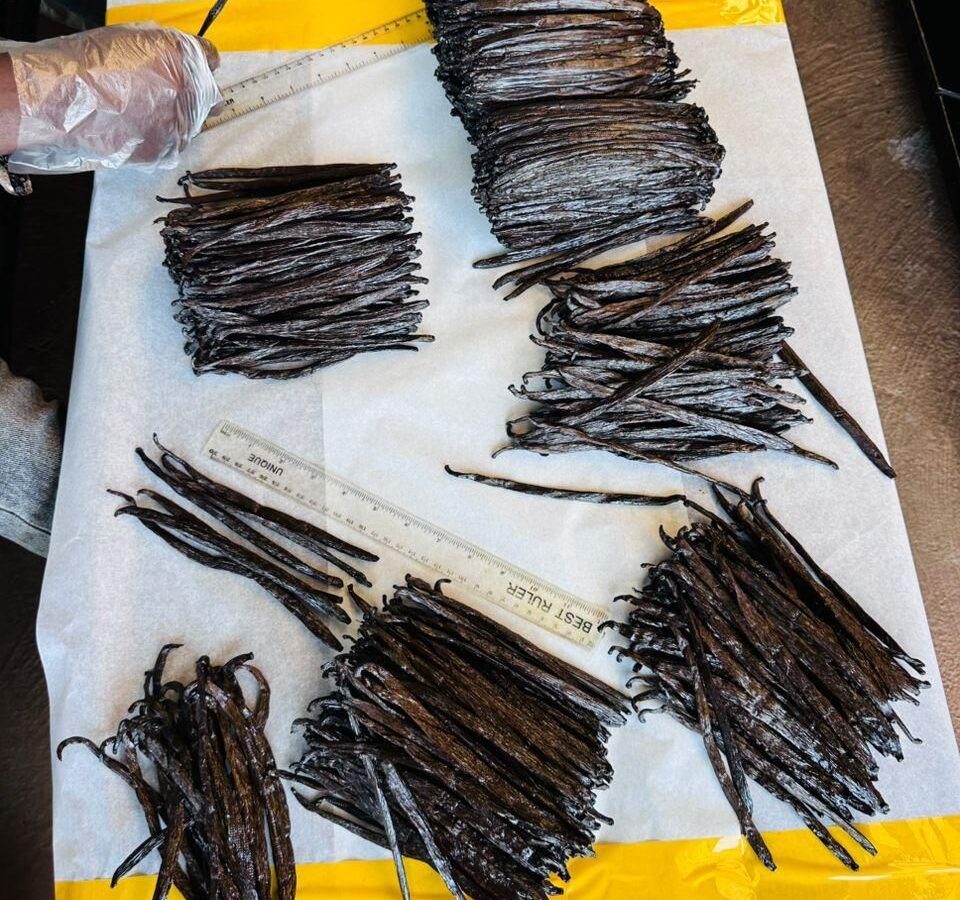
Why Madagascar dominates the market
Three reasons, and only one of them is about the bean.
- Scale and infrastructure. The SAVA region — Sambava, Antalaha, Vohémar, Andapa — has grown, cured and exported vanilla for over a century. The curing know-how, the exporters, the certification bodies and the shipping lanes already exist; no emerging origin replicates that in a decade.
- Consumer recognition. “Madagascar Bourbon” is the only vanilla origin the general public can name. On a pint lid or an ingredient panel it does commercial work no other origin does.
- A genuinely good, genuinely consistent profile. Cured properly by the Bourbon method — blanching, sweating, slow sun-drying, then weeks of conditioning in lined boxes — it produces the flavor the whole category was built on.
The dominance is also the risk. When 75–80% of world supply sits in one cyclone-exposed region on one annual cycle, every local shock is a global shock.
One harvest a year — and what that does to your planning
Madagascar’s vanilla year is a single, unforgiving sequence. Vines flower roughly October to December, and each flower is open for one day, so growers walk the vines daily and hand-pollinate individually. Pods then take six to nine months to mature. The harvest runs from roughly May–June into the autumn, with June at the heart of it. Curing and conditioning add another five to eight months before beans are export-ready.
Add it up and the beans you are quoted today were pollinated by hand somewhere between eighteen months and two years ago. Three consequences buyers feel directly:
- Price volatility is structural, not accidental. Market prices ran from around $20/kg in 2013 to roughly $600/kg by 2018 — Cyclone Enawo crossed the SAVA region in 2017 — and then collapsed again. One weather event decides a year of supply for the entire planet.
- Quality suffers in boom years. When prices spike, pods get picked early and vacuum-packed under-cured, because immature beans are worth stealing and mature ones are worth more per kilo than the risk of waiting. Vanillin does not develop in a pod picked green.
- You cannot fix a shortage inside the year. There is no second crop to correct a bad one. That is exactly the structural gap Uganda’s two annual harvests fill, and why most procurement teams now run Madagascar and Uganda side by side instead of choosing.
The practical advice: book Madagascar volume against a forecast, not against this month’s need, and keep a second origin qualified in your formulation so a spike does not stop your line.
Typical Madagascar grades
Madagascar grading follows the same two-tier logic as the rest of the trade, with local trade names layered on top. Common market ranges:
| Grade | Typical length | Typical moisture | Appearance | Bought for |
|---|---|---|---|---|
| Grade A / gourmet (trade names: “black”, “TK”) | 14–20 cm | ~30–35% | Dark, oily, supple, unsplit | Scraping for caviar, plated pastry, visible-seed products |
| Grade B / extract (“red”, splits and cuts) | 10–16 cm | ~20–25% | Drier, often split, reddish-brown | Extraction, infusion, anywhere the pod is discarded |
Market-typical ranges for Madagascar origin. Evanille publishes verified in-house moisture and vanillin figures only for the lots we cure ourselves; supplied-origin specifications are confirmed per lot on the COA.
Grade B is not inferior vanilla — it is drier vanilla, which means more flavor solids per pound. The arithmetic that settles that argument is in Grade A vs. Grade B. The equivalent products in our own Ugandan line are Grade A gourmet, extract grade and splits and cuts.
What Madagascar is best for
- Anything where the origin is on the label. If the pack says “Madagascar Bourbon,” the origin is the product and no substitution saves you money on net.
- Pale, delicate, gently cooked applications — crème anglaise, panna cotta, white chocolate ganache, buttercream — where a smoky or earthy origin would read as a defect.
- Classic vanilla ice cream aimed at a broad palate rather than a connoisseur one.
- Reformulation baselines. Bench any new origin against Madagascar before you switch a legacy product.
How to buy Madagascar vanilla beans from Evanille
We sell to the middle of the market — creameries, gelaterias, bakeries, chocolatiers, extract producers and small manufacturers buying by the pound and the kilo.
- Request a sample and run it through your actual process. Extraction, bake, churn — a bench test beats a spec sheet.
- Ask for current availability and lead time. Our Florida warehouse holds our Ugandan production for immediate nationwide shipment; Madagascar is a supplied origin, confirmed order by order, so we quote real dates rather than implied ones.
- Get the specification in writing — grade, length band, moisture, vanillin, lot and COA — before you commit volume.
- Ask us to compare. If your product runs hot, or has fat, sugar or alcohol fighting the vanilla, we will tell you honestly when Uganda gives you more flavor per dollar.
Text +1 786-896-8446 — we’ll call you back. Or request a quote and samples, review current vanilla bean prices, browse the full range of vanilla beans, or see bulk and contract terms.
FAQ
What are Madagascar Bourbon vanilla beans?
Vanilla planifolia pods grown in Madagascar and cured by the Bourbon method. “Bourbon” is a geographic designation covering the Indian Ocean islands — Madagascar, Réunion, the Comoros, Mayotte, Mauritius and the Seychelles — and takes its name from Réunion, which was called Île Bourbon until 1848. It refers to origin, not to a variety, a grade, or anything to do with whiskey.
Is Madagascar vanilla the same as Bourbon vanilla?
In practice, almost. All Madagascar vanilla is Bourbon vanilla, but not all Bourbon vanilla is Malagasy — Réunion, the Comoros and the rest of the island group qualify too. Since Madagascar grows the large majority of the crop, the trade uses the two terms interchangeably.
Why are Madagascar vanilla beans so expensive?
Two premiums stack. First, concentration risk: 75–80% of world supply comes from one region with one annual harvest inside a cyclone corridor, so every shock moves the whole market — prices ran from about $20/kg in 2013 to roughly $600/kg in 2018 before collapsing. Second, recognition: “Madagascar Bourbon” is the only origin consumers can name, and every link in the chain charges for the label.
Madagascar or Ugandan vanilla beans — which should I buy?
Madagascar if the origin appears on your packaging, or if the application is pale and delicate. Uganda if the vanilla has to survive heat, fat, sugar or alcohol, if you are buying flavor compounds per kilo, or if you need supply that does not depend on a single annual harvest. Plenty of buyers run both. The full side-by-side is in Ugandan vs. Madagascar vanilla.
Does Evanille own its operation in Madagascar?
No, and we say so plainly. Our own sourcing, curing, grading and quality-control facility is in Uganda. Madagascar, Ecuador and Indonesia are origins we supply through vetted partners, with specifications documented per lot. Full farm-to-warehouse traceability inside one company is a claim we make for Uganda only.
Can I buy Madagascar vanilla beans wholesale?
Yes — by the pound, the kilo or the case, with larger lots quoted under contract. Because Madagascar is a supplied origin rather than resident Florida stock, current availability and lead time are confirmed on request. Text +1 786-896-8446 or request a quote, and you will have dates and firm numbers, usually the same business day.